
By Dan LaRue | Man-on-the-Street Reporter
GLOUCESTER — The city-owned parcel known as I4-C2 sits along the Gloucester waterfront like a question that never got answered. It’s a scenic slab of uncertainty — 1.8 acres of gravel, unrealized ambition, and decades of failed plans.
On a humid June morning, I met with the lot just off Rogers Street — on-site, as it prefers. There’s no office, no structure, no shade. Just gravel, a parking kiosk, and a low hum of existential uncertainty.
“I’ve been described as ‘blighted, decadent, and substandard,’” the lot said. “Which, to be fair, in Gloucester is a pretty common personality profile.”
That description comes from the official determination made in April 1962, when I4-C2’s career began not with a ribbon-cutting, but with a label affixed by the Gloucester Housing Authority as part of its Downtown Urban Renewal Plan. The lot had once held a block of buildings and homes — some salvaged, many razed.
“They say urban renewal is like a fresh start,” said I4-C2. “In my case, it was more like being wiped clean and left alone for 60 years. It’s character-building. Or at least character-leaving.”
From the late 60s into the 80s, city officials struggled to figure out what to do with I4-C2. Early proposals floated a hotel, fish processing, and marine repair facilities.
“Oh yeah,” the lot said wistfully, “they were gonna put a ferry terminal on me. I bought a little sailor hat and everything.”
In 1983, the Gloucester Housing Authority — having transferred the property to the Gloucester House Restaurant and then having it returned to them — transferred the property to the Gloucester Redevelopment Authority (GRA), who then transferred it to Gloucester Landing Associates (GLA).
“I’ve been in and out of a lot of homes,” the lot said. “A lot of people had interest, but no one could handle me on my terms.”
Through the late 80s and early 90s, community conversations resumed around transforming the site into something aligned with Gloucester’s heritage. But nothing stuck: in 1996, a proposed plan was halted by the Department of Environmental Protection over zoning restrictions related to its location in a Designated Port Area (DPA).
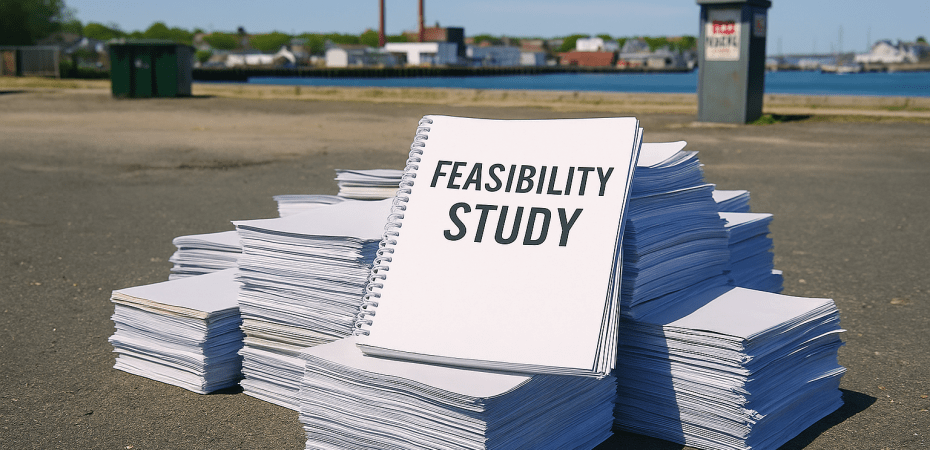
“You know how some kids get a hobby?” I4-C2 asks. “Mine was collecting feasibility studies.”
The lot spent the rest of the 90s and the first decade of the new millennium as the subject of failed deals and legal discussions. In 2010, I4-C2 officially became the responsibility of the City of Gloucester. By then, it had spent over 30 years unoccupied — a scenic place to feel the full weight of missed opportunity.
“I’m working on my boundaries,” the lot tells me. “Physically, they’re pretty defined. Legally, they’re contentious.”
In the early 2010s, the city worked on another round of proposals. Public forums, renderings, charrettes. City leadership had a new vision: “a new beginning for Gloucester,” according to Mayor Carolyn Kirk.
“The magic words,” I4-C2 sighs, kicking a rusty lobster trap. “Like calling something ‘artisanal’ or ‘farm-adjacent.’ Everybody loves saying it. Nobody knows what it means here.”
Most recently, the lot has served as parking and a staging ground for concerts and cautious dreams. But no permanent development has taken root. It’s still tied up in regulatory uncertainty, harbor compatibility issues, and the ever-thornier question: Who has the political will — and budget — to finally do something?
“I’m not asking for a skyscraper,” the lot says. “I’d settle for being a nice plaza with a bench and one of those historical plaques no one reads.”
As of 2025, I4-C2 remains vacant, owned by the city, and subject to DPA regulations that restrict use to water-dependent activities — or something with a waiver, if the process ever makes it that far.
“I’m trying to stay positive,” it says, its voice echoing through the docks. “I’ve made peace with the gravel. The birds are good company. And every once in a while, a child wanders in and asks, ‘What was this place?’ I tell them the truth: I was almost something.”
 The Dogtown Reader